GladiGala Overview - Kickstarter Prototype


I received a prototype copy of GladiGala in exchange for posting an overview.  The prototype I received came with standees, but the final version of the game will feature miniatures with removable bases.  My goal is not to convince you to back the game, but to let you know how the game plays so that you can decide for yourself if it's something you would enjoy.

Ancient Rome.  4 schools, pitted against each other in a match of strength and wits.   Their fighters gearing up for the ultimate arena battle to either capture another school’s Eagle and bring it to the safe zone, or amass coins and riches through strategic strikes upon their opponents.  

Such is the premise of GladiGala, the latest in Tyto Games INSYNC series of games.  First used in Final Act and further refined in Stone Daze, the INSYNC system is an innovative form of action programming (think RoboRally or Colt Express, but without cards) where players program their unit’s movements using a magnetic board that tracks not only movement, but whether the unit will turn or use its special powers.

Review: Santa's Workshop


I'd like to thank Rio Grande Games for supporting Women Like Board Games by generously providing a review copy this game.  I played Santa's Workshop 5 times and at all player counts before putting together my thoughts below.

A Christmas Tale

All Ben wanted for Christmas was a board game.  Not just any board game; Ben wanted a Christmas themed game that he could play with his family for the holidays and that his friends who are really into games could also enjoy playing with him.  He knew it was a big ask, so Ben wrote a letter to Santa, asking for the game he's always wanted...

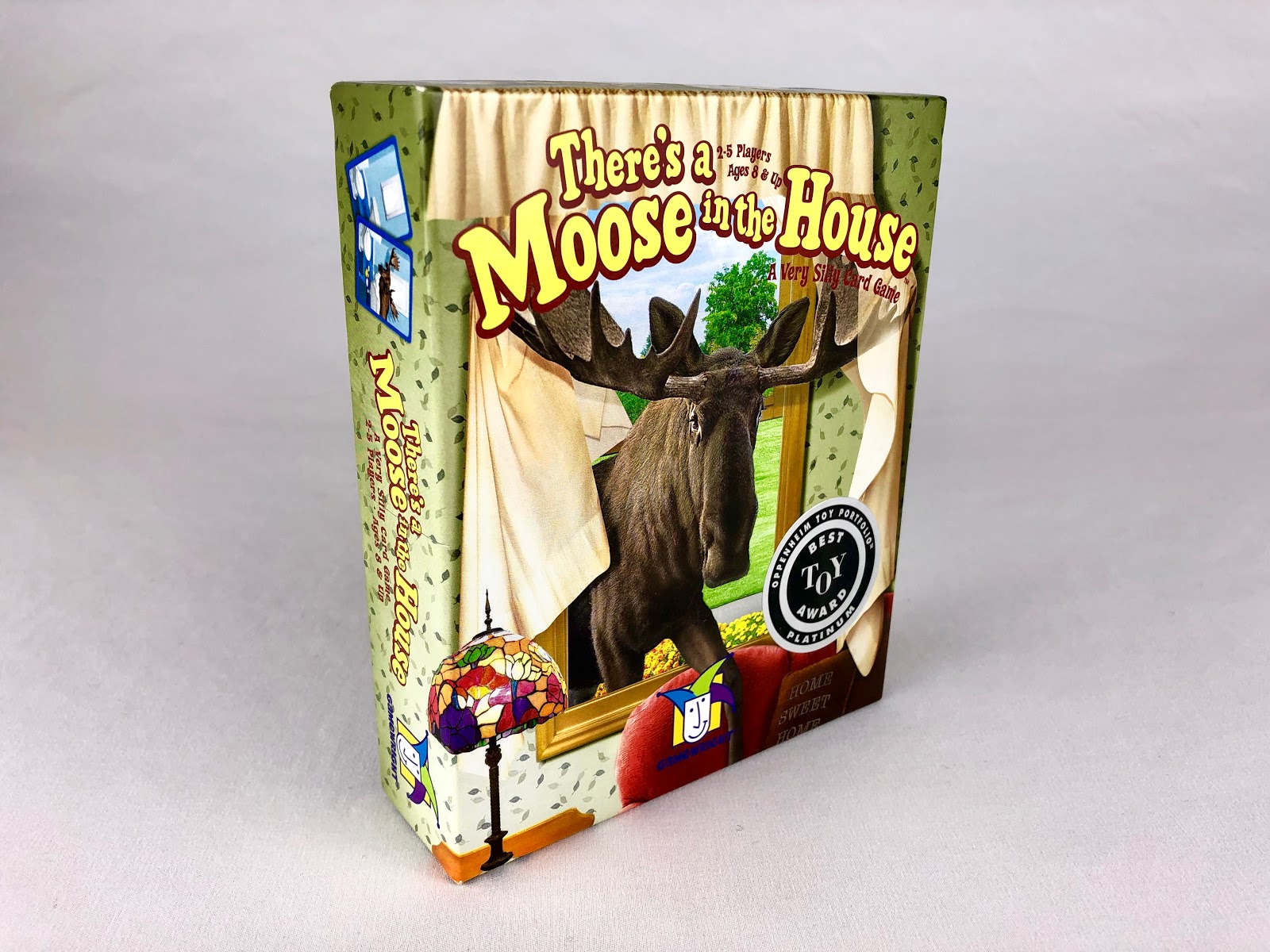
Review: There's a Moose in the House


I’m sorry Gamewright, theres’ only one way for me to put this:  There’s a Moose in the House is the single most inane game I have ever played.

And it’s wonderful.

Zoo-ography Overview - Kickstarter Prototype


I received a prototype copy of Zoo-ography in exchange for posting an overview of the game, which I passed on to another reviewer.  The final game will be for 1-4 players, but the prototype I received only included enough material for up to 2 players.  I played the game many times solo and once with an opponent.  The prototype I received also had some offset cards.  The habitat walls don't always line up exactly in the prototype, but will line up in the final version of the game.  My goal is not to convince you to back the game, but to let you know how the game plays so that you can decide for yourself if it's something you would enjoy.


Doomsday Robots is the successful publisher of the beautiful Bridges to Nowhere, and they're returning to Kickstarter with their equally stunning new game, Zoo-ography. Zoo-ography is a game with a simple rule set that belies the underlying challenge of not only drafting cards to create a zoo but drafting animals and attractions to place in your zoo to make the best zoo possible.

14 Games I'd be Interested in if I were Going to Gen Con

Each year, I become more and more jealous of those that are able to make it to GenCon and Essen.  The more I get into the hobby and the more games I play, the more interested I become in learning about the newest games coming out and the new innovations that are revealed at these conventions.  I eagerly watch social media, checking out posts on Twitter and Instagram of all the fun everyone else seems to be having while I'm stuck at work and playing old games at home.

But I can dream!  And if I were going to GenCon, these are 14 games that I would want to check out, in no particular order.

BILDER Overview - Kickstarter Prototype


I received a prototype copy of BILDER in exchange for posting an overview of the game, which was passed on to another reviewer.  I played the game 4 times with 3, 4, and 5 players.  The prototype I received seemed to be laser cut MDF.  I painted it silver for my own enjoyment, but the final version of the game will come with laser cut pieces made from quality, natural wood. My goal is not to convince you to back the game, but to let you know how the game plays so that you can decide for yourself if it's something you would enjoy.

I’m not usually a fan of party games or word games.  I’m not very good at thinking on the spot, and having to draw or act things out or get others to guess what’s going on in the crazy recesses of my mind never goes well.  So when I was asked if I’d like a preview copy of BILDER I was about to write it off, but out of curiosity I checked the YouTube links of how the game is played.  I found myself laughing aloud at some of the examples and getting excited at a game that’s basically an excuse for grown adults to play with blocks like small children.  I was taken in by the creativity the game encourages, and agreed to check it out.

Review: Holmes: Sherlock & Mycroft


Holmes: Sherlock & Mycroft


I’d like to thank the fine folks at Devir Games for supporting Women Like Board Games by providing a review copy of this game.  I played a total of 5 times with 3 different players before putting together my thoughts below.

Given the theme, Holmes: Sherlock & Mycroft seems it should be a game of deduction, testing the wits of the Holmes brothers as Mycroft tries to prove a boy’s guilt while Sherlock searches for clues to prove his innocence.  However, while you are gathering clues, there’s little deduction involved in this straightforward game of set collection.  What Holmes: Sherlock & Mycroft does offer is a quick, tight puzzle of balancing economy, efficiency, and luck.

Azimuth Overview - Kickstarter Prototype


I received a prototype copy of Azimuth in exchange for posting an overview of the game, which was then passed on to another reviewer.  I played the game 5 times with 2 and 4 players.  My goal is not to convince you to back the game, but to let you know how the game plays so that you can decide for yourself if it's something you would enjoy.

I hadn’t heard the term Azimuth until learning of the newest game from Tyto Games on Kickstarter.  Of course, I then had to know what an azimuth was, and the internet showed it to be a very confusing concept (for me at least).  I guess when you’re drifting alone on the open seas with only a compass and the horizon to keep you company, figuring out azimuth can be important to help you find your way home.  All you need to do is to find a fixed reference point in the sky (such as the North Star), and calculate the angle away from North or South in relation to the horizon… and you’d need to know how to do tangents, sines and cosines in your head… and you’d need to know what to do with that information once you had it…

Luckily when it comes to games, Azimuth a really cool title for a simple game that doesn’t require complex math to play!   

Review - Pandemic Legacy: Season 1 (Spoiler Free)


Pandemic Legacy: Season 1 is the best board gaming experience I’ve ever had.  It takes a game that I love and turns it into something so much more.  The basic premise is there, but it’s expanded upon, updated, changed, like a shape shifter constantly morphing from one figure to another as the campaign progresses.  It’s a roller coaster that takes you and your friends through highs and lows and twists and turns you’ll never expect; it’s exciting, and exhilarating, and exhausting all the same time.  And it’s wonderful.

Review - The Walking Dead Board Game


I have a love/hate relationship with The Walking Dead; something about the zombies grosses me out, but I enjoy the drama and psychological/philosophical musings of how people would react to such an apocalypse, yet somehow nasty zombies always pop up to ruin the only thing I do enjoy about the show.  I’ve only seen the first season fully and snippets here and there from other seasons.  I’m not saying I’m opposed to zombies in general, I just think they’re really gross on The Walking Dead, and they die in really gross ways, and they sound gross, and I just don’t like them.  So when my (non-gamer) friends said they had a Walking Dead board game they’ve owned for years but never played because the rulebook seemed confusing and asked me to help teach them the game, I agreed, because that’s what you do for friends.  For what it’s worth, this review is based only on the 4-player game.

Board Game Roundup

Cry Havoc and Scythe


Cry Havoc: This game had a lot of hype around it when it was first announced, but many people came away disappointed so it fell out of favor among the masses fairly quickly.  I'm assuming it didn't do very well because you can find it for as much as 50% off in online sales.  What turned a lot of people off is the seeming imbalance among the factions of the game, and that you only get 15 turns in the whole game which is not a lot to work with.

But for me?  I was hooked on my first game - its the first game in a long time that I wanted to set up and play again immediately.  Cry Havoc is an area control game in Euro style, meaning you're not trying to kill all of your enemies or wage constant war - you're simply trying to control areas with crystals, and if you can score the most points off of these crystals you'll win at the end of the game.  But to take and maintain control of these regions with crystals, you'll have to wage constant war and kill your enemies.  The game comes with 4 very different factions that all play differently, which is where questions of imbalance come in.  Some of the factions are easier to pick up and play than others, but after 4 games I can say that it does feel balanced once you know how to play the factions (though admittedly I played the blue Pilgrims the most and haven't figure out how to win with them yet!).

Board Game Roundup

7 Wonders Duel, Imhotep, and Lord of the Ice Garden

7 Wonders Duel:  I've never played 7 Wonders, but 7 Wonders Duel is a neat little 2-player only game of tableau building.  On your turn you have 3 options: construct a wonder, or choose a building (card) from the playing field and build it if you have the resources or sell it for gold.  Your built buildings become your "city" and they provide you benefits and resources for the rest of the game, which you can use to build new buildings or wonders (this is where the tableau building comes in).  The game plays over 3 ages and there are 3 victory conditions - military, scientific, and point counting if you get to the end of Age 3.  My first game was won by a military victory, but if it had gone to the end the other player would have won with double the number of victory points I had!  7 Wonders Duel is an award-winning game that I liked quite a bit since it's easy to pick up and play and requires some thinking and planning ahead, but the person playing with me wasn't that into it, unfortunately.

Board Game Roundup

Via Nebula, Islebound, and Evolution

Via Nebula Via Nebula is a route building and pickup and deliver game, beautifully executed and easy to learn.  The main focus of the game is constructing buildings, which you accomplish by transporting resources to construction sites.  Problem is, you can only move resources over certain routes which aren't built yet, and most of the resources are locked.  You and those playing with you will lay tiles down to create routes from the resources to your construction sites, but these tiles can only be placed on certain terrain which makes for an interesting puzzle in how to get resources where you want them to go.  You also each have two workers that you can use to unlock resources which gives you points, but comes at the cost of your little guy hanging out until all of the resources that were unlocked have been moved.  Buildings can be erected once you have the required resources, and they give you both points and a bonus action on the turn they're built.  The game ends when the first player builds their 5th building, but the winner of the game is the one with the most points. 

Via Nebula offers a simple concept with complex decision making, especially when playing with more than 2 players.  There's the puzzle aspect of figuring out how to get resources to your construction site, decisions to be made as to which resources to unlock and when (especially since your opponents can access those resources once unlocked), and deciding whether to erect an easy building or hold out for one that gives more points but costs more resources to build.   While it may seem like buildings will win you the game, I actually won having only constructed 3 buildings by focusing on laying tiles and unlocking resources.  

Review - Lords of Waterdeep

Man, I really wanted to be the builder.  Everyone knows I like being the builder.  At least they think I'm the builder - I bought buildings in the first three rounds to trick them, and now they're buying buildings left and right to try to stop me from getting any more.  This is a win-win situation for me, but nothing else this game is going my way.  I just finished a quest and need to pick up a new one, but only arcana and peity quests are available and I'm Durnan the Wanderer, the Lord who is hell bent on completing commerce and warfare quests.  Oh well, I gamble and place my agent on the option to reset the quests and pull 4 new ones:  arcana, piety, skullduggery, skullduggery.  Dang it!  I grab a skullduggery quest and it finally gets replaced with a commerce quest - which one of my opponents quickly snaps up and refills with another piety quest.  DANG IT!  It's my turn again, hmmm... The wizard spot is taken so I decide to recruit a cleric and smile inwardly as scowls form across my opponent's faces.  I didn't need a cleric, but they did...

Lords of Waterdeep is a game that takes placed in the Dungeons and Dragons world, but doesn't feel like D&D in any way.  It's a standalone game that I wouldn't have even known was related to D&D if it hadn't said "Dungeons & Dragons" on the box.  You don't have to be familiar with D&D to play the game and there's little back story or explanation on the cards or in the rule book, though if you're familiar with the series you'll enjoy the references on the board and throughout the quests.  

For those of you, like me, who aren't interested in D&D or want nothing to do with D&D, don't let that deter you from this excellent game. There's no role playing, no dice rolling, and completing quests isn't about telling stories, it's about collecting different colored cubes representing adventurers such as rogues, clerics, wizards, and warriors to earn perks and points. 

The way you collect cubes is through a mechanism called worker placement.  Lords of Waterdeep is my first introduction to worker placement games, and I have to say I'm a fan.  In this type of game, you put a marker on a spot to claim a specific action, and since Lords of Waterdeep limits your placement to one Agent (marker) per action it means that once claimed, no one else is able to take that action.  

Since there are only so many ways to collect cubes each round and all of your opponents have the same goal as you, it allows for passive aggressive conflict without actually having to do anything to your opponents.  It also means you have to come up with plans and backup plans to accomplish your goals, in case someone takes a spot you wanted.


Oldies but Goodies


The aMAZEing Labyrinth

Some might say we’re in the “golden age” of board games - over 5000 games were released last year alone -  but it's classic games that still dominate the market.  Connect4, Twister, Guess Who, Scrabble, and Monopoly are still in the top 20 best selling board games on Amazon, despite being around for 40 - 80 years.  These games might not get great reviews on sites like boardgamegeek, but they hold a special place in our hearts.

I was at a thrift store recently and found a game that holds that special place in my husband's heart: a Ravensburger classic, The aMAZEing Labyrinth.  As an American you may be more familiar with Ravensburger puzzles than board games, but in Europe Ravensburger is king.  Ravensburger games give Europeans the same sense of nostalgia that Hasbro or Milton Bradley games give us.  So when I found The aMAZEing Labyrinth for $2.00, I figured it wasn't a bad price to pay for nostalgia.

I hadn't heard of this game until I saw my nephews playing it in Holland, and when I asked about it my husband's response was, "What?  You've never heard of Dolhof?!?" (Dolhof = laybrinth in Dutch) It looked interesting enough; there's a maze that shifts constantly, and you're trying to get to certain places on the board and return back to your starting place before everyone else. I just had never heard of it, even though it was released in the US in 1986 and has many different versions today (including Disney versions, which proves it's legit).

So we sat down to play what I assumed was just a silly kids game, but turned out to be fun and challenging, even for adults.  Don't get me wrong, it is a silly kid's game with child-friendly figures of ghosts, spiders, knights, swords, and anything else you might find in a haunted castle, but the constantly changing layout of the maze provides a minor brain workout even if the theme falls flat.  Cards matching pictures on map tiles are dealt to each player, and the goal is to "collect" all of the items on your cards and return to your starting tile.  Sounds easy enough, right?

The challenge comes in having to move the maze every turn, and the fact that not all parts of the maze can move.  You shift the maze by sliding a tile into the end of a row, and the next player uses the tile that came out the other side to shift the maze on their turn.  Once you shift the maze you can move your piece through the hallways of the labyrinth towards your goal.  Your focus is on reaching your objective, but if your target isn't on a static board piece not only is the maze constantly shifting, your destination is shifting as well.

Add to that the fact that you're also trying to thwart your opponent's ability to travel through the maze and you've got an easy to learn game that poses more of a challenge than initial impressions imply.

You'll find yourself staring at the board for a few minutes (or maybe 10) deciding how to shift the maze and move around, and whether it's better to block your opponent or focus on your objective, or if you can do both!  You'll get frustrated by wanting to shift a static row, or wanting to shift the maze back to how it was before the last player took their turn, which isn't allowed.

I quickly learned to take advantage of a rule that says if you knock a player off of the board when shifting the maze their piece is put on the tile that was just inserted, as it provides an easy way to get to the other side of the board and still allows you to move after you're transported.  My husband's strategy is to block me in every turn if possible, so it takes me more turns to get to where I need to go.  His strategy seems to work better, because he wins more often than I do.

More than I do?  That's right, we played more than once and have played almost every day since we got the game!  It's simple, short, easy to set up and take down, doesn't require too much thought, is highly luck based (it all depends on which destination you're trying to reach next and how the maze shifts), and poses enough of a challenge to keep our interest.  What I initially thought would be a cheezy purchase that would end right back up at the thrift store is now a staple in our board game collection.

We may think of classic games as kids games, not worth our time as adults, but they're classics for a reason, able to stand the test of time and begging to be played again and again.  Don't count these bad boys out because you're a designer game aficionado, they just might surprise you from time to time.


Women Like Board Games Rating:

https://womenlikeboardgames.blogspot.com/p/rating-system.html


**Full Disclosure: I paid for this game with my own, hard earned money**

Why I Like Board Games

The other day my husband asked me why I like board games so much. He plays both board games and video games, but I’ll take a board game over a video game any day. Part of the reason is that I’m a tactile person. If there’s a button, I’m going to push it, and if something looks like it might be soft, I’m going to touch it. I like picking things up and moving pieces around the board, it’s just my nature. However, there is a deeper, more philosophical reason I prefer board games to video games. 

It all has to do with books. Books, and the difference between books and movies. And quantum mechanics, but we’ll get to that later. 

One of the things I love about books is that, while the author’s words set the stage for the experience, your imagination creates the world in which the book takes place, and for every person that reads the same book a different world is created in their minds. Everyone reading a book has a different idea of what the characters look and sound like, how the buildings in cities look, what a watch the character wears looks like, etc. 

Sure, the author might give specifics – perhaps the character wears a vintage Mickey Mouse watch that has a scratch on the face, gold trim, and a brown, leather armband – but it’s up to the reader to imagine the rest. In this case, how thick is the armband? How big is the face of the watch? How wide and deep is the scratch? Does the scratch interfere with the ability to tell time? Is it a normal watch with regular hands, or do Mickey’s eyes or arms act as the minute and second hands? Is it so old Mickey is black and white, or is he in color? 

A movie, on the other hand, establishes all of this for you. The way an actor portrays a character determines what the character sounds like and her mannerisms. The costume designer chooses how she dresses, and the exact watch she’s wearing. And the director and set designers control what the world looks like and how it’s portrayed. By the time you see the movie all of these decisions have been made for you by someone else, and everyone in the audience is experiencing the same thing. 

It's kind of like quantum mechanics, you see.

In one theory of quantum mechanics, all things exist in all possible states until they’re observed (or measured). Once observed, these possibilities collapse into a single reality and the other states no longer exist. An example of this is the famous Schrodinger’s Cat thought experiment. In short, there’s a cat in a box that has a 50/50 chance of being dead, but there’s no way to tell if it’s dead or alive until you open the box. If someone hands you this box how do you know if the cat is dead or alive? The theory is that it exists in both states until you open the box, in which case both states collapse into a single state (alive or dead). 

And that’s exactly what a movie does to books. An individual book creates one possible world in the reader’s mind, and for each person that reads this same book a different world is created. If infinite people were to read the book, then infinite, different worlds would exist in people's minds. These are the quantum possibilities. However, once someone makes a movie these possibilities collapse into a single world that the makers of the movie created, and all people who see the movie observe this same quantum state. If you try to read a book after you’ve seen the movie, it’s hard to imagine it any different. 

So what does all this have to do with board games and video games? Board games are like books, and the pieces in the game are like the words on a page. They set the stage and explain things, sometimes even in great detail, but when you play the game you build the world and events that happen in the game in your own mind. When someone creates a video game, they create this singular world for you. 

For instance, let’s say you’re playing a game and someone draws a card that says “Cave in! The walls shake and the ceiling crumbles, burying you in rubble.” Even if this card has a picture of the cave in, you get to imagine what that cave in sounded like, whether there was a scream, how bad the player is injured, etc. In a video game, you’d walk into a room and the walls would shake and the ceiling would crumble, perhaps a pipe on the wall bursts, but every time you play this game it will always look and sound the same. There’s no other way to imagine it because someone else has already created the entire cave in experience for you and you’re simply observing it. 

And that’s why I like board games more, I get to imagine how it all goes down and create my own world as I play. Board games are full of quantum possibilities.  While I enjoy the amazing artwork in many video games, I find them a passive experience where I’m in the back seat, simply along for the ride. In board games, I get to drive.

Board Game Roundup

Board Game Roundup
Splendor, Betrayal at House on the Hill, Shadow Hunters*


Splendor:  Splendor was a game that I found quite zen.  There's no contact between players, very little tension (unless someone reserves a card you really want), and not a whole lot of forward planning.  You start out collecting chips that represent different gems.  On each turn you can choose to collect 3 different gems, or two of the same gem as long as there are at least 4 available.  As the game progresses you use these gems to purchase cards.  Each card requires a different number of gems to purchase and provides you with a free gem or points and a free gem, but unlike chips the cards (and gems on the cards) stay with you for the remainder of the game and can be used on any round.  There are also nobles - I guess that's what they are, they all looked like they were pretty upscale back in the 1600's - who provide you points but no gems if you meet a certain condition, such as having collected 3 cards each of 3 different kind of gems.  The first person to 15 points wins.

There isn't a whole lot going on in this game, but I can see why people like it and why it was nominated for and won so many awards.  It plays quickly (~30 mins), scales nicely from 2 to 4 players, and as long as they can count and know their colors, any age of gamer can enjoy Splendor with equal chances of winning.  This isn't something I'm going to rush out and buy after having played once (which I have been known to do), but if someone has it and wants to play I wouldn't turn it down.

Review - Star Realms


Star Realms

Some Background:

I have to preface this with the fact that Star Realms is the first deckbuilding game that I can remember playing, unless you count card games played as a kid (think: War, Slap Jack, Egyptian Ratscrew). I had never heard of Dominion, for instance, and had no idea what to expect when we went to play this game. Please grant me your graces for being a noob to hobby board gaming!

In the game store, my husband was super excited when he saw there was one box of Star Realms left; it was something he had read about online and wanted to try out. The price was right so I didn’t complain (too much) when he bought it. He sold me on the fact it was a 2-player game, though nothing about it appealed to me in any way. I watched him play with friends, and while they enjoyed it and told me it was a great game and the artwork was stellar (pun intended), it took a lot little bit of coaxing to get me to play with him.

The thing is, I’m not a huge fan of space themes (unless they’re cutesy, like Star Munchkin). I like Star Trek well enough, and have seen Star Wars, Stargate, and lots of other things because my husband is so into it, but after giving up the dream of being an astronaut at 8 years old the theme lost its appeal for me. I’d rather play a game of Sid Meier’s Civilization than Galactic Civilization, for instance, even if GalCiv has better mechanics and whatever else my husband tries to explain to me. That being said, I did finally play Star Realms with the hubby after a bit of kicking and screaming, and to my surprise it’s become one of my favorite games!